Top 7 Mobile App Development Trends Businesses Should Watch in 2026
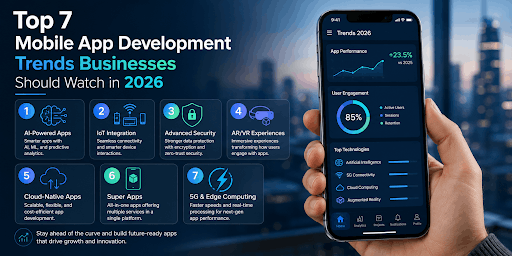
Key mobile app development trends shaping enterprise app strategies and user experience in 2026.
The first quarter of 2025 was Celine Ndoye’s time spent reviewing all mobile touchpoints her retail banking division has for customers.Celine Ndoye’s time in 2025 was spent auditing every mobile touch point that her retail banking division had to offer to customers. The exercise was not as easy as she thought, it was more uncomfortable. Technically the main banking application developed by her Mobile App Development Company was working and two thirds of user base were using it. However, a trend had arisen when it came to churn data: younger customers (those under 35) were departing for challenger banks based on the features the app lacked – not the features it provided. An up-to-date categorization of expenditures, which would be updated as they arrived. Customer inquiries about their account made in a conversational manner without going to a particular screen. When a sensitive action was detected, seamless biometric re-authentication on the go.
All those functions were part of her bank’s technology pipeline, somewhere. All were yet to enter production. When she pointed out the problem to the executive committee, she knew her argument was simple: the application’s now out of step with what users expected wasn’t an application development backlog issue. This was a problem with awareness of the trend. The key decisions that will help the bank to be competitive in 2027 would need to be made in 2025, as building for a market peak is more about joining the game than differentiating from the pack. This blog spills the seven mobile development trends that are emerging and becoming mainstream in 2026 in advance of the churn data for the Celine in your organization.
1. AI-Powered Personalization at the Individual Level
In 2022, mobile apps brought segmentation in the form of personalisation. Users were segmented by general behavior or even demographic attributes and they were given experiences that matched their segment, not their users. One has come, the segment of one. Today, AI models are able to learn from individual interaction history, real-time behavioral signals, and contextual data, to provide experiences that are tailored for each user, and segment-based approaches can’t match these capabilities.
For businesses, the takeaway is that apps that need to use a rule-based recommendation engine and static content personalization are missing the level of experience that AI-driven apps provide. If a person’s spending behavior indicates that they may have some disposable income, the financial services application that displays the specific savings goal message at that time is doing something qualitatively different from the application that sends a generic nudge to anyone who does not open the savings module every 30 days. What makes certain apps intelligent vs automated is the technical infrastructure needed for the former behavioural event pipelines, real-time model inferences, and feedback loops that enhance recommendations over time.
2. On-Device AI and the Privacy Architecture Shift
The trend of pushing AI inference from the cloud to the device is one of the most significant architecture changes in the mobile, and it has implications that extend beyond just performance. Inference on the device with Apple’s Core ML and Neural Engine or with TensorFlow Lite and Google’s AI Edge SDK on Android means that the data put into a model stays there. That privacy property is becoming more of a regulatory mandate and user expectation for applications that involve health data, financial behavior, communications content, and location history.
The practical implications of this transition are optimization work done by pure application developers that has not been their responsibility in the past: optimising models to run efficiently on device hardware that has limited capabilities; ensuring that accuracy does not degrade after compression; and creating infrastructure for keeping on-device models up to date without forcing application updates for every model improvement. What this does mean is that features that wouldn’t be viable with cloud processing, as users just won’t allow that data to leave their device, become viable. That capability enhancement is justifiable optimization effort for an ever increasing class of applications.
3. Super App Architecture and the Consolidated Experience
The super app model, in which a single application aggregates multiple services into a unified experience that retains user attention within one platform rather than distributing it across many, has been the dominant mobile commerce structure in Southeast Asia and China for years. In 2026 it is actively reshaping Western market expectations through a different mechanism: the ecosystem consolidation strategies of established players who are adding adjacent services to retain users they might otherwise lose to specialized applications.
Businesses building mobile products in categories adjacent to higher-traffic platforms need to evaluate whether a standalone application strategy remains viable or whether their product’s strongest distribution path runs through a larger platform’s ecosystem. For businesses with sufficient user bases of their own, the question is which adjacent services they should be bringing inside their application to increase the switching cost that comes with consolidated experience. A loyalty application that adds payment, a retail application that adds financial products, a healthcare application that adds wellness coaching: each expansion deepens the platform’s role in the user’s daily life.
4. Voice and Conversational Interfaces
By integrating LLM, voice and conversational interfaces have become a possibility in mobile applications at a level of quality they were incapable of achieving before. The earlier conversational UI, the awkward, inflexibility of intent-based chatbots that couldn’t deal with ambiguity is a different product category than LLM-powered interfaces that understand natural language, can follow multiple turns of conversation, and answer based on the intent behind the question and not the words used.
When investing in the right voice capabilities, the strategic question for businesses is what user tasks are not well supported by the traditional navigation and tap interface and best supported by conversation. Candidates include complex queries that involve multiple conditions and/or multiple sources of information, as well as tasks that involve synthesizing information from multiple sources, and interactions that involve a back and forth clarification process. Well-integrated conversational interfaces in 2026 are being used to execute specific tasks of high value, not to eliminate all navigation in an application, which results in an application that’s not a good app nor a good chatbot.
5. Advanced Biometrics and Continuous Authentication
The biometric authentication model that most mobile applications use, a single verification event at session start that then grants broad access until the session times out, is being replaced in security-sensitive categories by continuous authentication models that reassess trust throughout a session based on behavioral signals. Keystroke dynamics, device handling patterns, location consistency, and interaction timing all provide authentication signals that don’t require active user participation and that can trigger re-verification when anomalies are detected.
For banking applications like the one Celine was auditing, this shift means that a suspicious action late in a session can prompt biometric re-verification without requiring the user to re-login entirely, which maintains security without destroying the experience. For healthcare applications, it means that a prescription request made after an unusual activity pattern can be flagged for additional verification before proceeding. Face ID and Touch ID provide the verification mechanism; behavioral analytics provide the signal that determines when verification is warranted.
6. Augmented Reality in Practical Commercial Contexts
The AR hype cycle has come and gone, giving rise to a series of novelty features that people tried and then discarded. What is being displaced is the use of AR in specific commercial environments where it is solving a real problem sufficiently for the customers to pick up the bill: Furniture visualization, which helps to lower return rates by allowing customers to see furniture in their own space; Vehicle inspection tools, where the AR overlays instructions to assess a vehicle conforms to a standard; Industrial maintenance, which overlays assembly and repair instructions on actual equipment so that it is assessed in the same way as a standard.
The maturity of ARKit and the ARCore for Android has brought down the cost of building good AR features, enabling them to be practical for mid-market apps too, not just enterprise deployments with special budgets for custom AR hardware. In 2026, it isn’t much of a challenge to access the technology, it’s more about the user task and the application in which AR improves the outcome measurably over a photo or a written instruction.
7. Sustainability and Energy-Efficient Code
This is the trend that top mobile app development companies began treating seriously in 2024 and that is becoming a purchasing criterion for enterprise application buyers in 2026: the energy consumption footprint of mobile applications, both in device battery drain and in the server-side infrastructure that applications depend on. Corporate sustainability commitments that extend to software procurement are creating demand for applications whose energy efficiency has been measured, optimized, and disclosed.
For development teams, this is from a nice-to-have to a customer requirement in enterprise sales cycles, and that is a positive development.For development teams, it’s a positive development that performance profiling with energy impact as an explicit metric, is no longer a nice-to-have in enterprise sales cycles, but a customer requirement. The measurement tools are from Xcode and Android Studio, and it’s the practice of doing something about what they show up during development instead of after complaints come in that sets the best apps apart from the rest. Background processing which causes unnecessary awakening of devices, unnecessary keeping of radios on when networks are not needed, and implementation of animations that keep the CPU frequency at its maximum when it is not needed are all optimization targets that have user experience and sustainability implications.
What Celine Did With Her Findings
Celine’s audit yielded a 36-month product roadmap, which were broken down by trends that were of the utmost relevance to her bank’s competitive position. She placed a focus on on-device AI for spending insights, as this addressed the privacy concerns her compliance team had highlighted around the inference of financial behavior data is cloud-based. She asked to have a prototype of the conversational interface created for the use case that was most commonly leading to her having to engage in support calls: account query. She postponed AR integration until a specific application, based on location insights from the properties, was validated with user research guided mortgage affordability assessment.
The roadmap was adopted by the executive committee. More importantly, they created a quarterly trend review process as an ongoing governance procedure and thus the next mobile change would be reviewed before it became apparent in churn data. That is the organizational posture on the governance side, the ability to watch trends structurally not reactively that really matters more than any one technology option on the roadmap.