SWP in Mutual Fund vs SIP: Which Strategy is Better for You?
SWP in mutual funds
Mutual funds are gaining popularity in wealth building, and this allows for an individual to match their investment with their financial goals. Among the many options available Systematic Investment Plans (SIPs) and Systematic Withdrawal Plans (SWPs) have become like the two go to plans. SIPs are primarily for wealth creation but SWPs function more steadily when it comes to cashing out and serve as a good alternative when the regular cash flow demands are there. Let’s explore the benefits and the distinctions between SWP in mutual funds and SIPs, to help you determine which option aligns with your financial goals.
SIPs and SWPs are explained.
What is Systematic Investment Plan (SIP)?
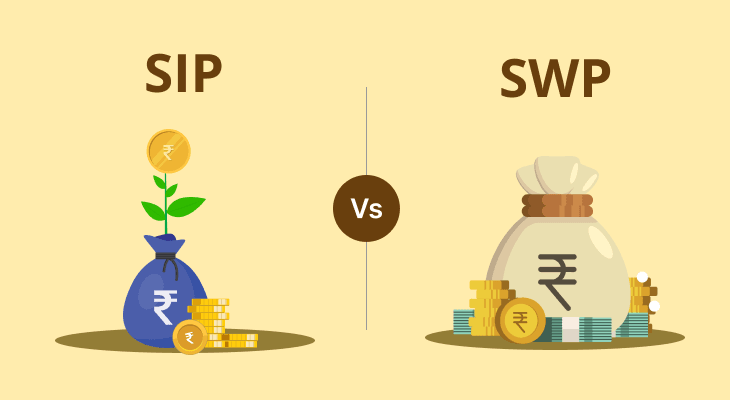
A Systematic Investment Plan (SIP) lets investors put in a fixed amount into a mutual fund scheme at regular, intervals like monthly or quarterly. This approach helps with more disciplined investing and it also, somehow uses market movement to the advantage via dollar cost averaging where the average purchase price can come down slowly over time.
What is Systematic Withdrawal Plan (SWP)?
A systematic withdrawal plan (SWP) is another option which allows investors to withdraw a fixed sum from their mutual fund investment at regular intervals, such as monthly, quarterly or annual intervals. It can be very useful for individuals who want to have a steady income for example retirees or anyone who is trying to fund certain objectives of their life, such as college tuition or even acquiring a house.
Similarities and dissimilarities between SIP and SWP in Mutual Funds
While comparing SWP in mutual funds with SIP, investors should take into account different factors which include risk tolerance, investment goals, and investment horizon.
1. Purpose of Investment
Wealth building is the primary goal and purpose of an SIP and not simply trading. Those who use this approach typically desire to build a substantial corpus over time and for longer-term goals like retirement or school tuition – yes, both. These SIPs sail through the booms of the market and during the process, compound the returns over the years, which adds up, albeit little by little.
In contrast, SWPs are for investors seeking steady cash flow from their investments. This is a good option for those who are looking to sell their investments or for those people who are retired. The dual advantage that an SWP provides is systematic withdrawal plan as well as growth of investments.
2. Flexibility
SIPs are flexible in terms of investment quantum as well as the frequency. These investors can make a small investment, and keep adding money to their investments as they are able. Additionally, they can transfer their funds when their danger tolerance or monetary goals vary.
SWPs, however, offer flexibility with regard to the withdrawal of money. The investors can choose the amount and the periodicity of their withdrawals. They can also modify or discontinue their SWP anytime they want to, giving them control over cash flow.
3. Tax Implications
Each strategy has a tax impact and it is important to fully understand that tax impact in order to do appropriate financial planning. Long term capital gains tax (LTCG) is applicable in case of redemption of mutual fund units, where the redemption value is calculated and the mutual fund has been redeemed for more than 36 months.
SIPs and Taxes: SIPs are meant for investments, therefore, the gains that are realised on redemption may be subject to LTCG tax especially if the investments are held for more than 12 months. The current policy provides for taxing on gains if the income is more than ₹1 lakh with 10% tax rate
With respect to SWP, capital gains are also a factor: SWP’s can also result in capital gains tax with regard to the withdrawal. However, part of your investment might be taxable as SWPs are usually made periodically. It’s essential to have knowledge of LTCG tax because it can have an effect on your overall returns and can also have an effect on your withdrawals approach.
For more in-depth information on long-term capital gains tax, you may want to refer to Understanding Long-Term Capital Gains Tax at Bajaj Finance
4. Market Conditions
The effectiveness of the investing strategy can be greatly influenced by the market conditions. For the most part, SIPs work well in the bull market but it slowly accumulates wealth over the course of the market rally. But the SWPs can also provide the liquidity that people need during a market downturn, so that they don’t need to sell their entire portfolio.
5. Investor Profile
The other factor that determines the choice between SIPs and SWPs is the investor’s profile. While SIPs could be helpful for creating wealth for long-term investors with high-risk appetite, SWPs could be useful for investors who are looking for regular income, such as retired people. Learning as much as you can about your finances will help you make good decisions.
What’s the optimum approach to your money goals?
It could be determined by the financial objectives, risk tolerance, and period of time. SIPs are a great choice for those who are focused on long-term investments and can handle the ups and downs of the market. If you are looking for a regular income, however, you may prefer to consider the SWP option.
Conclusion
Both SWP in mutual funds and SIPs are great financial tools, when used properly. Regardless of the approach you take, it’s important to make sure it fits with your personal financial objectives, risk tolerance, and market conditions. Regularly review investment portfolio and seek personalised advice from a financial adviser. The end goal of investing successfully is to make informed investment decisions, and to make decisions that are best for YOU, your finances, and your family.
Embarking on your investment journey can profoundly shape your financial future. SIPs can be invested in or redeemed with understanding and strategy and the financial goal will be achieved efficiently.
Author:
Trending Search Write For Us Technology